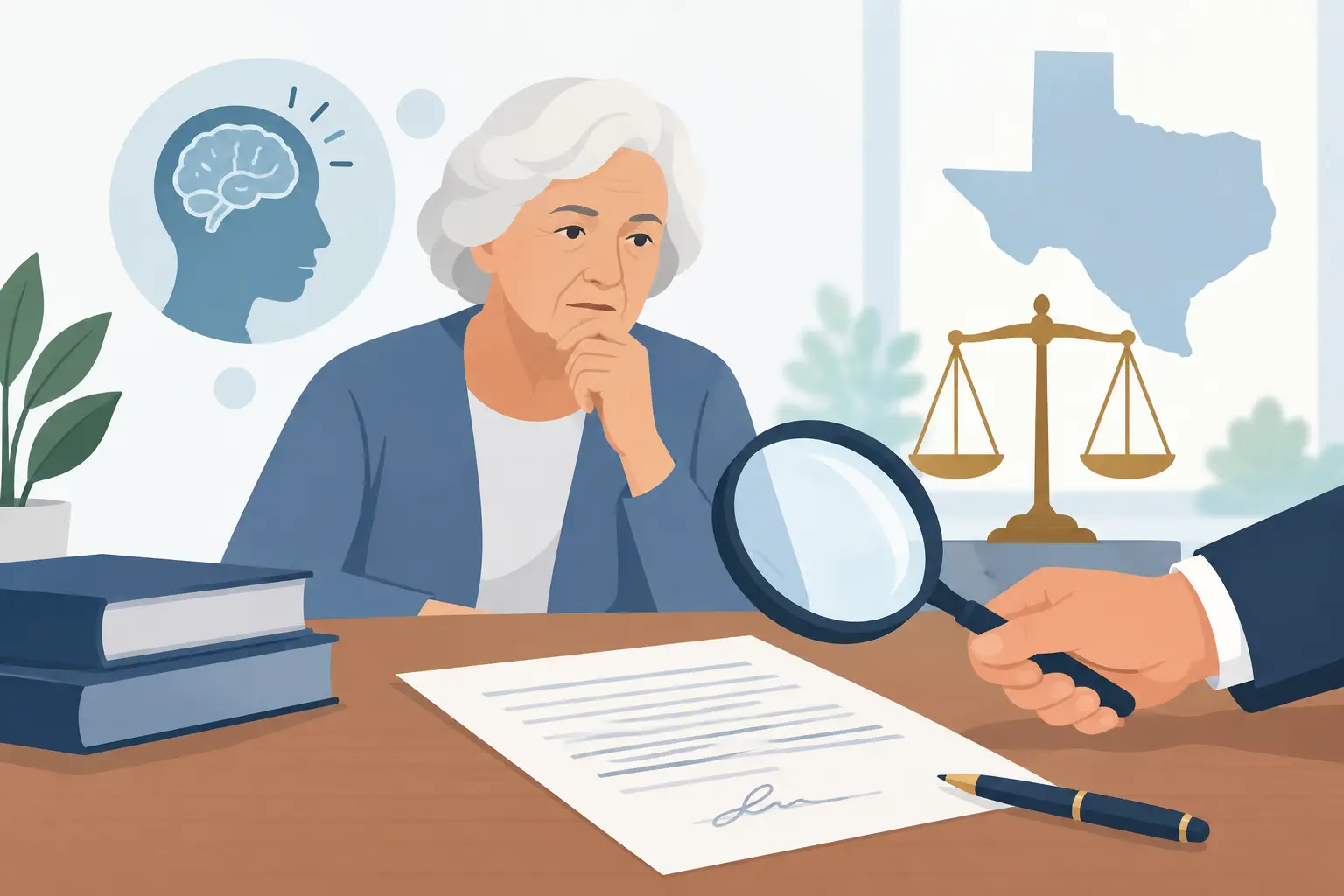
A will can look perfectly valid on paper and still be challenged after a death. When a family raises a claim of lack of testamentary capacity in Texas, the question is not whether the person was elderly, ill, or making an unpopular decision. The question is whether that person had the legal mental capacity to make that particular will at the time it was signed.
That distinction matters. A successful capacity challenge can change who inherits, whether an earlier will controls, and how long an estate remains tied up in probate court. It can also turn an already difficult loss into a serious family dispute. Clear answers, prompt document preservation, and a careful review of the facts can make a meaningful difference.
What Testamentary Capacity Means in Texas
Texas law does not require a person making a will to have perfect memory, flawless judgment, or a medical diagnosis-free life. Many people with dementia, serious illness, depression, or physical limitations may still have testamentary capacity at a particular point in time.
Generally, the person signing the will must be able to understand the business they are engaged in, the effect of making a will, the nature and extent of their property, and the people who would naturally be expected to receive that property. They must also have enough memory to hold those facts together long enough to make a reasonable decision about distributing their estate.
The legal focus is narrow but demanding: capacity on the date the will was executed. A person may have periods of confusion and periods of clarity. This is sometimes called a lucid interval. A medical record from months before or after the signing can be useful, but it does not automatically prove what the person understood during the signing ceremony.
When Lack of Testamentary Capacity in Texas Becomes a Dispute
Capacity questions often arise when a new will makes a major change shortly before death. For example, an older parent may leave most of an estate to one child after years of treating children equally. Or a new friend, caregiver, neighbor, or recently involved relative may receive a substantial gift while long-standing beneficiaries are removed.
Those facts can justify closer review, but they are not proof by themselves. Texas residents generally have the right to make unequal gifts, exclude relatives, or change an estate plan. The issue is whether the change reflected the testator’s own informed decision.
A challenge may be more credible when the will was signed during a hospitalization, shortly after a major stroke, during a period of advanced cognitive decline, or while the person was heavily medicated. Concerns also increase when the person could no longer manage basic finances, repeatedly forgot close relatives, did not recognize their own property, or relied entirely on someone who benefited from the will.
Capacity claims frequently overlap with allegations of undue influence. They are separate legal issues. A person can have testamentary capacity and still be improperly pressured into a will. Conversely, a person can lack capacity even if no one pressured them. The evidence may overlap, but each claim must be evaluated on its own legal standard.
The Evidence That Usually Matters Most
In a will contest, broad family opinions rarely decide the case. Courts look for evidence tied closely to the execution of the will and the testator’s actual mental condition. The strongest cases usually come from a detailed timeline, not one dramatic allegation.
Witnesses at the Will Signing
The testimony of attesting witnesses can be highly significant. They may describe whether the testator appeared alert, understood the document, answered questions appropriately, and signed voluntarily. If the will was prepared by an attorney, that attorney’s notes and testimony may also address the discussions that occurred before signing.
A properly conducted signing meeting can provide meaningful evidence of capacity. For that reason, careful estate planning often includes direct conversations with the client, independent of family members who may benefit from the plan.
Medical and Care Records
Medical records may show diagnoses, medication changes, cognitive testing, hospitalization, or observations about confusion and decision-making ability. Records from physicians, nurses, home health providers, assisted living facilities, and hospice personnel can all be relevant.
Still, a diagnosis is not the final answer. Alzheimer’s disease, for example, may support concerns about capacity, but it does not establish incapacity on every day of the illness. Likewise, a record stating that a patient was oriented can be helpful to the will’s proponent, but it may not resolve whether the person understood a complex change in an estate plan.
Everyday Conduct and Financial Records
People who interacted with the testator regularly may offer useful observations. Family members, friends, neighbors, bankers, caregivers, and business associates may know whether the person understood their finances, recognized familiar people, and could discuss decisions rationally.
Financial records can provide context as well. Unpaid bills, unexplained transfers, repeated scams, sudden changes in account access, or an inability to understand basic transactions may support a capacity concern. On the other hand, evidence that the testator continued to manage accounts, pay bills, communicate clearly, and make consistent decisions can support the validity of the will.
Prior Estate Planning Documents
Earlier wills, trusts, beneficiary designations, and letters of instruction can show whether the challenged will was consistent with a long-standing plan or represented a sudden departure. A change is not automatically suspicious. Families change, relationships change, and assets change. But a sharp change without a clear explanation may deserve careful examination.
What Families Should Do When They Have Concerns
The period after a death is not the time to rely on assumptions. If you believe a loved one lacked capacity when signing a will, preserve information before it disappears. Save text messages, emails, calendars, photographs, financial statements, and notes that may help establish a timeline. Identify the people who spent time with the deceased around the date the will was signed.
Avoid confronting witnesses or accusing relatives before you understand the available facts. Emotional conversations can make a dispute harder to resolve and may cause people to become defensive. It is usually more productive to obtain the will, identify its signing date, compare it with prior documents, and review the circumstances surrounding its preparation.
Texas probate deadlines can be unforgiving. The correct response depends on whether the will has already been filed, admitted to probate, or is being used in another proceeding. The procedural posture can affect available options, deadlines, and the burden of proof. Waiting too long may limit a family member’s ability to challenge a will or protect an inheritance.
Defending a Will Against a Capacity Challenge
Executors and beneficiaries should take capacity allegations seriously, even when they believe the will accurately reflects the deceased person’s wishes. A prompt defense often begins by securing the original will, the drafting attorney’s file, witness information, and records showing the testator’s condition near the signing date.
A defensible estate plan is not necessarily one that treats every heir equally. It is one that can be explained through reliable evidence. If a parent intentionally chose to favor a child who provided years of care, gave more to a disabled beneficiary, or excluded an estranged relative, the supporting facts and planning records may be critical if a dispute follows.
Not every disagreement belongs in court. Some cases involve legitimate uncertainty, incomplete records, and family members who need a practical resolution rather than years of litigation. Others require decisive courtroom preparation because the estate, the evidence, and the family relationships leave little room for compromise. The right approach depends on the documents, the timing, and the strength of the available proof.
A capacity dispute can affect far more than a single document. It can alter an estate plan, delay distributions, increase costs, and deepen family divisions. Whether you are questioning a will or defending one, early legal guidance can help you protect evidence, understand the probate process, and make decisions based on facts rather than family pressure.